
AI Engine
2min read
Dobbin
Dobbin: Softlandia helped build a scalable AI business, resolving architecture debates and accelerating product speed.

Gen AI and LLM development challenges from real projects. What breaks, scales, and lasts in production AI apps.
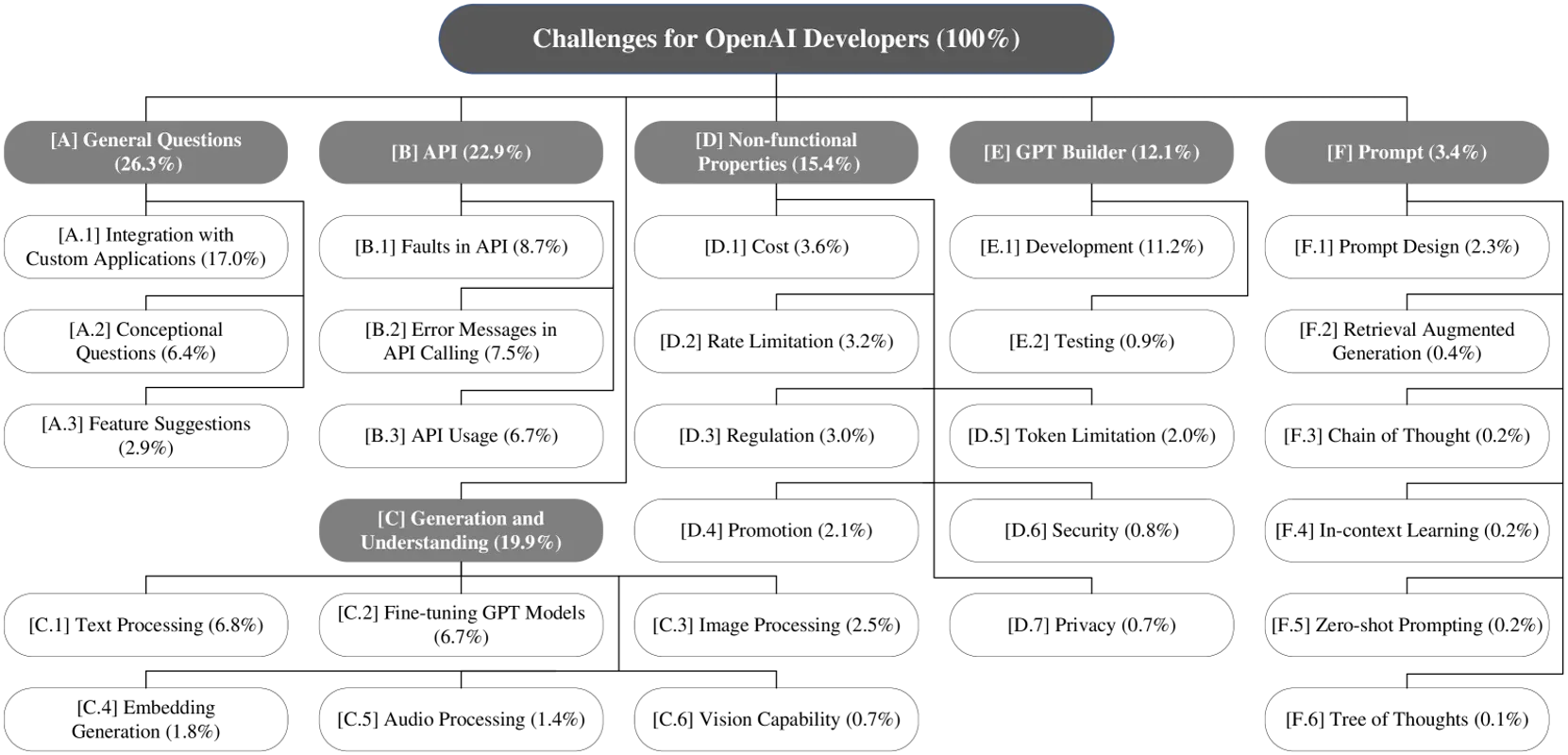
As Generative AI (Gen AI) and Large Language Models (LLMs) become integral to the software landscape, developers are encountering unique challenges when building applications with these cutting-edge technologies.
A recent study researched developer issues by analyzing over 29,000 from an OpenAI developer forum. The goal was to uncover common pain points and understand the real-world difficulties faced by those developing with Gen AI and LLMs, particularly in the OpenAI ecosystem.
In this blog post, we’ll walk through the key insights from this research and provide some takeaways on how developers can overcome these challenges.
One of the major hurdles identified by developers is integrating LLMs into existing or new applications. While APIs make these integrations theoretically easier, the complexity of embedding an LLM into a software architecture poses a significant barrier. Developers are often unclear about how to structure the interaction between an LLM and their application’s workflows.
Adopt modular AI architecture that
Rely on community-driven resources or OpenAI’s forums for integration examples and support
APIs are central to leveraging LLMs in applications, but many developers encounter API-related frustrations. These include cryptic error messages, poorly documented usage limits, and cumbersome authentication processes. Given the dynamic nature of LLM outputs, developers often spend considerable time troubleshooting.
Fine-tuning LLMs to deliver the desired outputs remains an intricate process for developers. Issues arise in generating consistent, high-quality responses, whether for customer service, content creation, or code generation applications. Additionally, developers struggle with optimizing LLMs for specific domain knowledge or tuning models for nuanced tasks.
A significant consideration in LLM development revolves around non-functional properties like cost, privacy, and security. Deploying large models is resource-intensive, making it crucial to budget for compute costs while ensuring privacy and data security regulations are met. Additionally, balancing performance with costs, especially under restrictive rate limits, adds an extra layer of difficulty.
OpenAI’s GPT Builder tools, encompassing both ChatGPT plugins and custom GPTs, are designed to meet diverse user needs. While these technologies share a common technical foundation, developers frequently encounter challenges during both the development and testing phases.
Finally, the art of crafting effective prompts, also known as "prompt engineering," remains an essential skill for LLM developers. Writing prompts that produce consistent and useful outputs can be frustratingly difficult, especially for more nuanced tasks like code generation, summarization, or conversational agents. Developers often face challenges with "Retrieval-Augmented Generation" (RAG), where the model must fetch and utilize external information sources.
A critical insight from this research is the potential future-proofing challenge for developers. Many current infrastructures make it difficult to replace or upgrade LLMs as newer versions become available. This can lead to escalating costs and inefficiencies down the road.
To mitigate this risk, developers should build their applications with flexibility in mind. Implementing modular AI architectures that allow for easy swapping of LLM models as well as other components will reduce technical debt and ensure long-term success.
Developing Gen AI and LLM apps poses unique challenges that go beyond traditional software development. By understanding the key pain points such as integration issues, API complexity, fine-tuning, and prompt engineering, developers can take proactive steps to overcome these barriers. Staying informed, building flexible AI architectures, and leveraging community support will be crucial as this field continues to evolve.
To dive deeper into these insights and learn how you can tackle these challenges in your projects, check out full research findings here.
P.S. If you’d like to watch how Bytewax developed a Slack bot with Softlandia during a live workshop streamed online, please click here.
Jaakko (Jack) Timonen

Jaakko (Jack) Timonen
Advisor, Partner

Testimonials
I really appreciate Mikko! He improved LlamaIndex's Qdrant integration by fixing critical issues in the QdrantVectorStore API—enhancing query accuracy, reliability and performance of LlamaIndex.


Jerry Liu
CEO & Co-founder, LlamaIndex
Mikko is awesome! He built a prompt support system for Guardrails AI back when OpenAI's API only supported basic text completion. His solution improved the quality of language model outputs.


Shreya Rajpal
CEO and Co-founder, Guardrails AI
Working with Softlandia was great! Mikko and Henrik built a Slack bot integrated with real-time RAG pipelines, delivering instant and accurate answers to questions. The bot was created during a live 2-hour session streamed on YouTube.


Zander Matheson
CEO & Co-founder, Bytewax
We love Olli-Pekka! He added support for dynamic Bearer Token authentication in the Qdrant client, enabling customers to integrate seamlessly with Azure and other platforms.


Andre Zayarni
CEO & Co-founder, Qdrant
Dobbin: Softlandia helped build a scalable AI business, resolving architecture debates and accelerating product speed.
Softlandia transformed Kuullas’ platform into an operational AI-powered matchmaking engine for employee mental coaching
Softlandia built an AI engine for Amplify to surface insights, compare initiatives, and guide smarter decisions.