


Become an Applied AI Engineer. On a Real Project.
We don’t train you in a classroom. We bring you into a live client project, alongside our engineers, and you build real things together. That’s how the learning sticks.
APPLIED AI ENGINEER
What is an Applied AI Engineer?
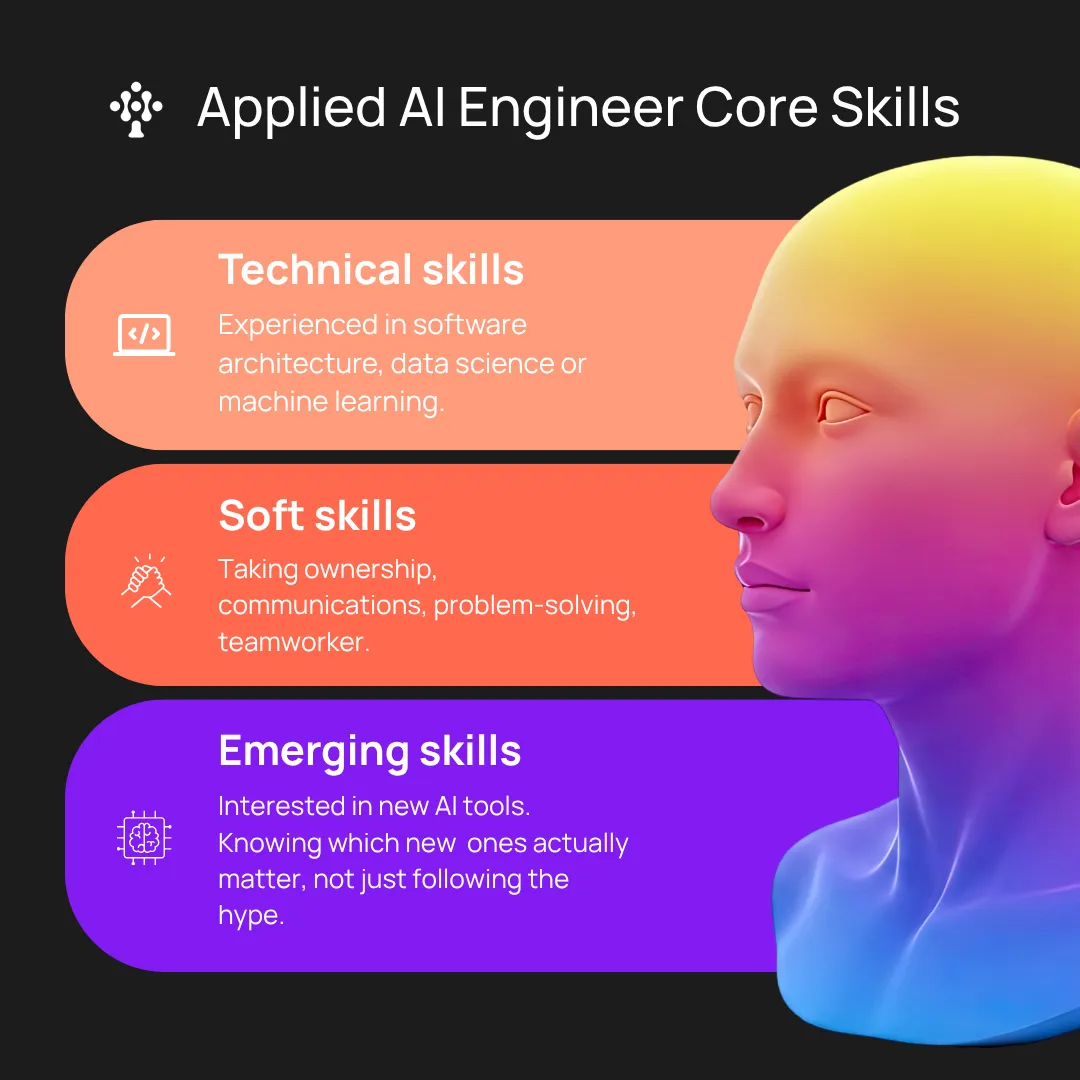
An applied AI engineer bridges software development and AI. It is someone who can architect and ship production-grade systems that use AI in ways that actually matter. Not just calling an API. Not just running experiments.
Tools of the AI Engineer
The stack and practices behind real AI systems
Best Way to Build an AI Engine in 2026
Architectural decisions that hold up in production
Applied AI — Where consulting ends and AI engineering begins
Tools of the AI Engineer
The stack and practices behind real AI systems
Best Way to Build an AI Engine in 2026
Architectural decisions that hold up in production
Applied AI — Where consulting ends and AI engineering begins
Become ai engineer
Your Two Paths in
You are a strong engineer. AI is the missing part
Maybe you have ten years in backend, cloud architecture, or full stack. Your fundamentals are solid. You’ve played with AI on the side or maybe even shipped something small, but you haven’t gone deep. You know enough to know you want more.
That’s exactly who this is for.
We won’t make you sit through basics you already know. We’ll put you in a project where your engineering skills are immediately valuable, and where you’ll build the AI expertise alongside our team, in context, with real problems.
Six months later, you’ll feel it and so will your clients.
That’s exactly who this is for.
We won’t make you sit through basics you already know. We’ll put you in a project where your engineering skills are immediately valuable, and where you’ll build the AI expertise alongside our team, in context, with real problems.
Six months later, you’ll feel it and so will your clients.
Coming from data, ML or AI?
If your background is in data science or machine learning, you already think in models. You’ll be immersed in production-grade full stack work — engineering practices, architecture decisions, and delivery discipline that turn a model into a product people rely on.
The applied AI engineer is proficient in both. That’s the bar we’re working toward together.
The applied AI engineer is proficient in both. That’s the bar we’re working toward together.
First months
How it Works
If you match the skill set to become an applied AI engineer, your time with us would look like this.
Step 1: Get up to speed
You start by studying where AI is today. The tools, the patterns, and the state of the art.
Then you build something with it. A demo, a proof of concept, something you’re genuinely curious about. This gets you oriented and gives you something to talk about from day one.
Then you build something with it. A demo, a proof of concept, something you’re genuinely curious about. This gets you oriented and gives you something to talk about from day one.
Step 2: Join a real project
You join Softlandia on a client project. A senior Softlandian works alongside you for the duration of that first assignment — not as a trainer with a syllabus, but as a colleague solving the same problems.
There’s no curriculum. No sandbox. No simulated data. You work on something real, with real stakes, using the tools and practices that are shaping how software gets built today.
This is what separates it from a bootcamp: you don’t upskill and then apply. You upskill by applying.
There’s no curriculum. No sandbox. No simulated data. You work on something real, with real stakes, using the tools and practices that are shaping how software gets built today.
This is what separates it from a bootcamp: you don’t upskill and then apply. You upskill by applying.

What You'll Gain
Working on a real project means you leave with something real, more than skills. You’ll have done work that matters.
Hands-on experience with top AI tools and practices
A shipped project and real outcomes on your CV
Production-grade engineering craft
Do impactful work at the frontier of technology
your next step
Ready to Grow?
Read the stories of engineers who didn't start in AI. You could be next.
