
AI Engine
2 min read
Dobbin
Dobbin: Softlandia helped build a scalable AI business, resolving architecture debates and accelerating product speed.

AI makes software cheaper to build. Deciding what deserves to exist, earning users’ trust, and learning what works still require attention.
AI has changed the economics of building software.
Teams can prototype ideas in hours that previously took days. Features that might have required weeks of engineering can sometimes be put in front of a user in an afternoon. Instrumentation, analysis, and iteration are getting cheaper too.
That creates an opportunity—and a new way to waste money. When building gets cheaper, it becomes easier to build too much.
The limiting factor was never only our ability to produce code. We also have to decide what deserves to exist and understand whether it works.
Those things haven’t become abundant just because code has.
In his 1971 essay “Designing Organizations for an Information-Rich World”, economist Herbert Simon described a similar problem:
“A wealth of information creates a poverty of attention.”
His point was that when something becomes abundant, its production cost stops telling you the whole story. Information might be cheap to produce, but somebody still has to spend scarce attention consuming it.
Software increasingly has the same problem.
Every new capability asks something from a user. They have to discover it, understand it, decide whether they trust it, and incorporate it into how they work.
It asks something from the organization too. Someone has to understand what was built, observe how it performs, support it, interpret the feedback, and decide what happens next.
That means the cost of a feature isn’t just the cost of building it.
The bottleneck moves to either side of the build: deciding what deserves the team’s attention, and making something that deserves the user’s.
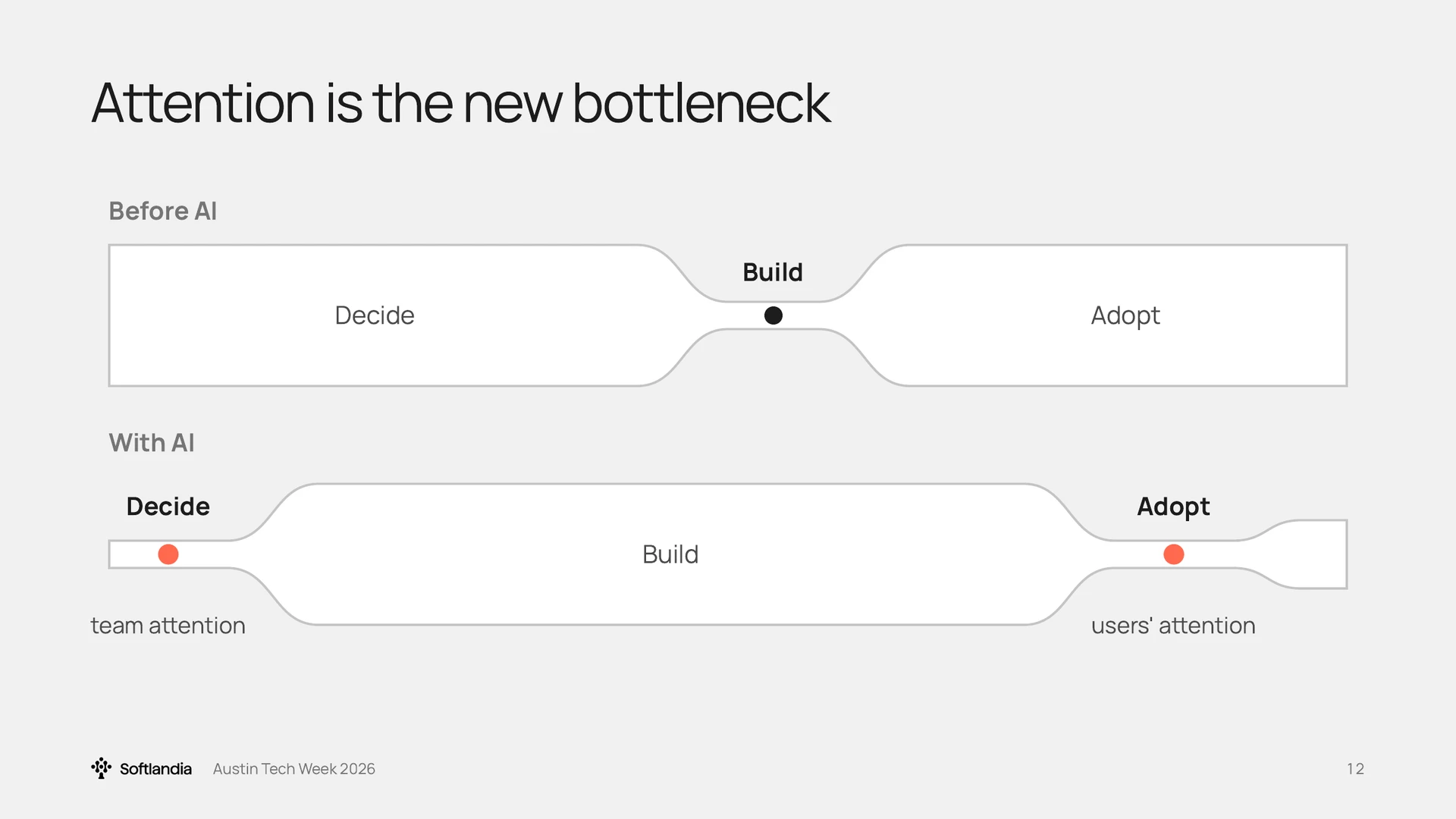
As building gets cheaper, deciding what to build and helping people adopt it still require attention. From our Austin Tech Week talk.
Research shows how users feel this cost. The 2005 Feature Fatigue study found that people tend to value additional capabilities more before using a product than after using it. More features can make a product initially more attractive while ultimately making it harder to use and less satisfying.
As AI makes it easier to add features, teams have more opportunities to create that burden.
When implementation was expensive, completing a large body of software represented a significant accomplishment. In an AI-assisted development environment, output itself tells us less.
What matters is whether we’ve solved the problem.
That requires getting software in front of real users and observing what happens. Depending on the product and its scale, that evidence might come from usage analytics, qualitative feedback from a handful of champion users, controlled experiments, or some combination of them.
There isn’t one universal metric. The important part is creating a feedback loop where evidence can change what you do next.
Don’t use AI simply to move through the existing roadmap faster. Use the increased speed to reduce the risk of the roadmap being wrong.
Prototype competing ideas earlier. Put working software in front of stakeholders and users sooner. Instrument what you release. Make the outcomes visible to the people making investment decisions. When evidence contradicts an assumption, preserve enough flexibility to change direction without tearing down months of work.
In other words, optimize for learning velocity, not just delivery velocity.
AI can help us research, prototype, build, measure, and iterate. Across that loop, people still need to judge where their attention will make the most difference.
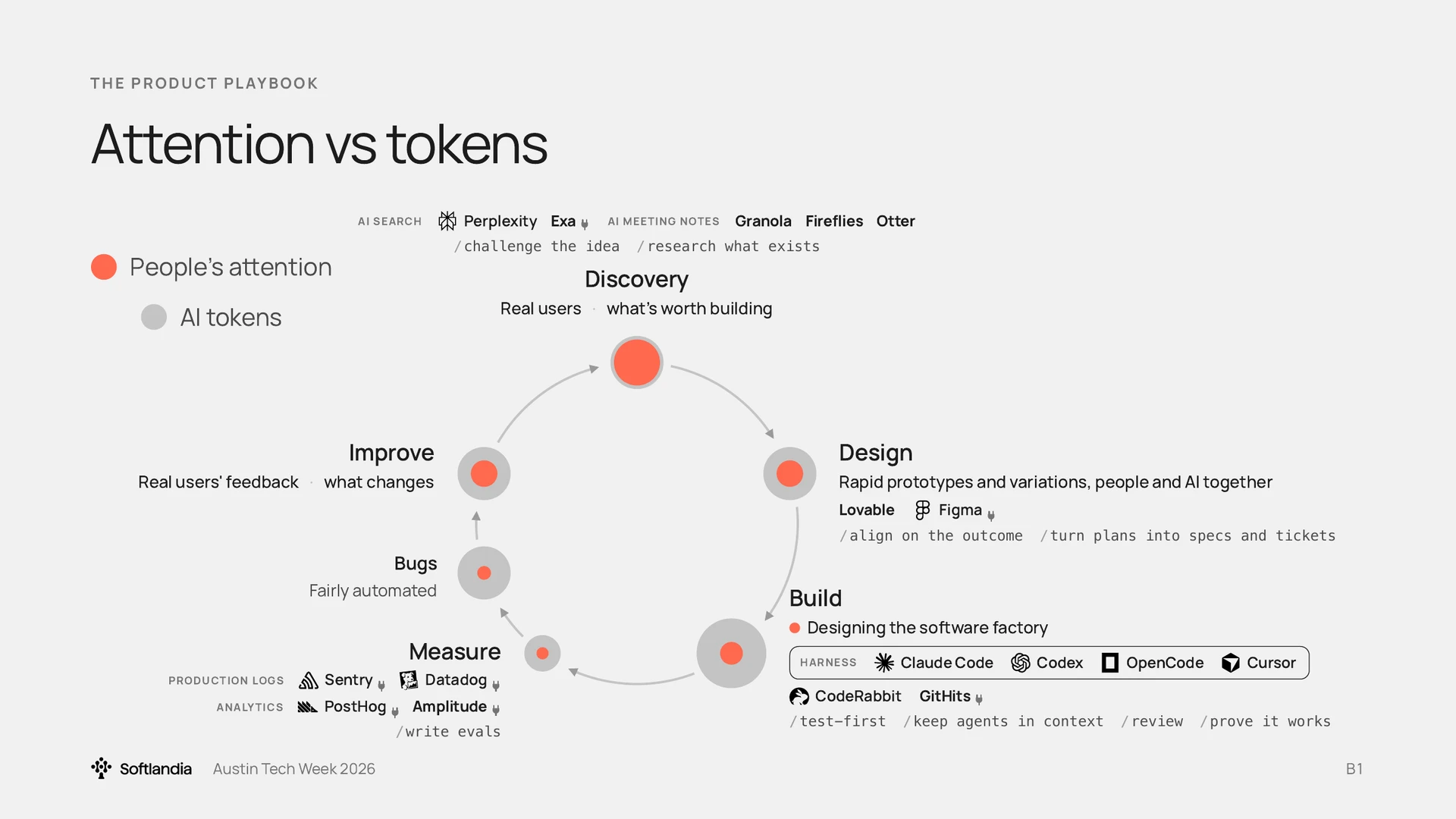
Attention and AI tokens across the product loop. The circles illustrate the idea; they are not measured allocations. From our Austin Tech Week talk. View full-size diagram.
That doesn’t mean recklessly shipping half-finished software. Risk is contextual.
Teams still need to identify their hard constraints. Where can trust be lost? Which mistakes are recoverable? What needs to be correct before it ever reaches a user? Security, safety, regulatory requirements, and irreversible actions can demand significant investment before release.
The goal isn’t minimum engineering. It’s the appropriate level of investment for what you need to learn and the risk you’re taking.
That judgment also can’t be outsourced entirely to an engineering team.
The people making decisions about what gets built need visibility into what happens afterward. Otherwise, the company may receive software without learning what to do next.
Over time, this becomes a practice: defining what is good enough, making outcomes visible, involving users continuously, and resisting hypothetical perfection when it prevents you from learning.
AI gives us better tools to build and learn.
The opportunity isn’t simply to produce more software for the same money.
It’s to find out whether we’re building the right software before we spend too much money, attention, and trust finding out the hard way.
Luke Otwell

Luke Otwell
Applied AI Engineer

Testimonials
I really appreciate Mikko! He improved LlamaIndex's Qdrant integration by fixing critical issues in the QdrantVectorStore API—enhancing query accuracy, reliability and performance of LlamaIndex.


Jerry Liu
CEO & Co-founder, LlamaIndex
Mikko is awesome! He built a prompt support system for Guardrails AI back when OpenAI's API only supported basic text completion. His solution improved the quality of language model outputs.


Shreya Rajpal
CEO and Co-founder, Guardrails AI
Working with Softlandia was great! Mikko and Henrik built a Slack bot integrated with real-time RAG pipelines, delivering instant and accurate answers to questions. The bot was created during a live 2-hour session streamed on YouTube.


Zander Matheson
CEO & Co-founder, Bytewax
We love Olli-Pekka! He added support for dynamic Bearer Token authentication in the Qdrant client, enabling customers to integrate seamlessly with Azure and other platforms.


Andre Zayarni
CEO & Co-founder, Qdrant
Dobbin: Softlandia helped build a scalable AI business, resolving architecture debates and accelerating product speed.

Softlandia transformed Kuullas’ platform into an operational AI-powered matchmaking engine for employee mental coaching
Softlandia built an AI engine for Amplify to surface insights, compare initiatives, and guide smarter decisions.